

The pharmaceutical industry advances on medical discoveries, but the progress is often slowed down by the weight of its own paperwork. Every milestone, from pre-clinical trials to commercial launch demands layers of regulatory, clinical, and quality documents. Teams spend weeks or sometimes even months drafting, reviewing, and reworking CTDs, SOPs, safety reports, and a host of relevant documents.
These documents carry more weight than ever: regulators expect full traceability, clarity, and compliance. Failure can lead to rejections, delays, or costly recalls. A 2025 report estimates that the pharmaceutical industry invests $50 billion annually in compliance spending globally, with even a single major compliance failure costing upwards of $12 million. (Source: GMP Pros)
This work exists across every function, creating a bottleneck that silently pushes timelines and inflates budgets. Let’s take a closer look.
The Scale of Documentation in Pharma and Why It Becomes a Bottleneck
Documentation is pervasive across Pharma, not just in one corner. Here’s how broad it is:
- Regulatory Affairs: Full CTDs, dossiers, health authority responses.
- Clinical Development: Protocols, CSRs, informed consent, investigator brochures.
- Pharmacovigilance: PSURs, DSURs, safety narratives.
- Quality & Manufacturing: SOPs, deviation logs, CAPAs, validation reports.
- Medical Affairs: Research papers, HCP communication documents.
- Market Access: HTA dossiers, value propositions tailored to local markets.
Because much content is reused across documents, countries, and at various stages of development, it piles on the authoring work, and the usual methods can't keep up. All this manual documentation, scattered across different departments, is a major reason why authoring and document management in pharma takes up valuable expert time and drains resources.
The reasons why this happens are pretty clear:
The work is highly manual, repetitive, and slow.
- Experts often spend large amounts of time on document tasks rather than core science. In regulatory publishing, authors may spend “hundreds of hours” just formatting, linking, and verifying summary documents (for a 200-page section of a new drug application)
Content is duplicated across functions, geographies, and submissions.
- A major challenge in pharma document control is that teams often rely on siloed systems (e.g. regulatory, quality, clinical tools), which leads to manual copying, conflicting versions, and missed steps.
- In FY 2024, more than 3,000 FDA Form 483s were issued across regulated areas, and over 60 % of those were related to “inadequate procedures, poor documentation practices, and quality system failures.” (Source: Atlas Compliance)
Regulatory precision means every update triggers cascading rework.
- A minor change to a data point may require updates to numerous sections of regulatory and other quality documents.
- This rework magnifies the time and cost, contributing to the estimated $2.3 billion it takes to bring a new drug to market. (Source: Deloitte).
Compliance pressures lead to multiple, lengthy review loops.
- Each manually drafted document must pass through several layers of review from different departments, adding weeks or months to the authoring timeline.
The net result is clear: documentation delays timelines, inflates costs, and diverts experts away from science.
What AI Can Do Today (with SyncIQ’s AI-Powered Authoring and Document Management)
SyncIQ’s AI-powered authoring and document management offers a path out of this drag by automating repetitive work, embedding compliance, and freeing experts for what matters.
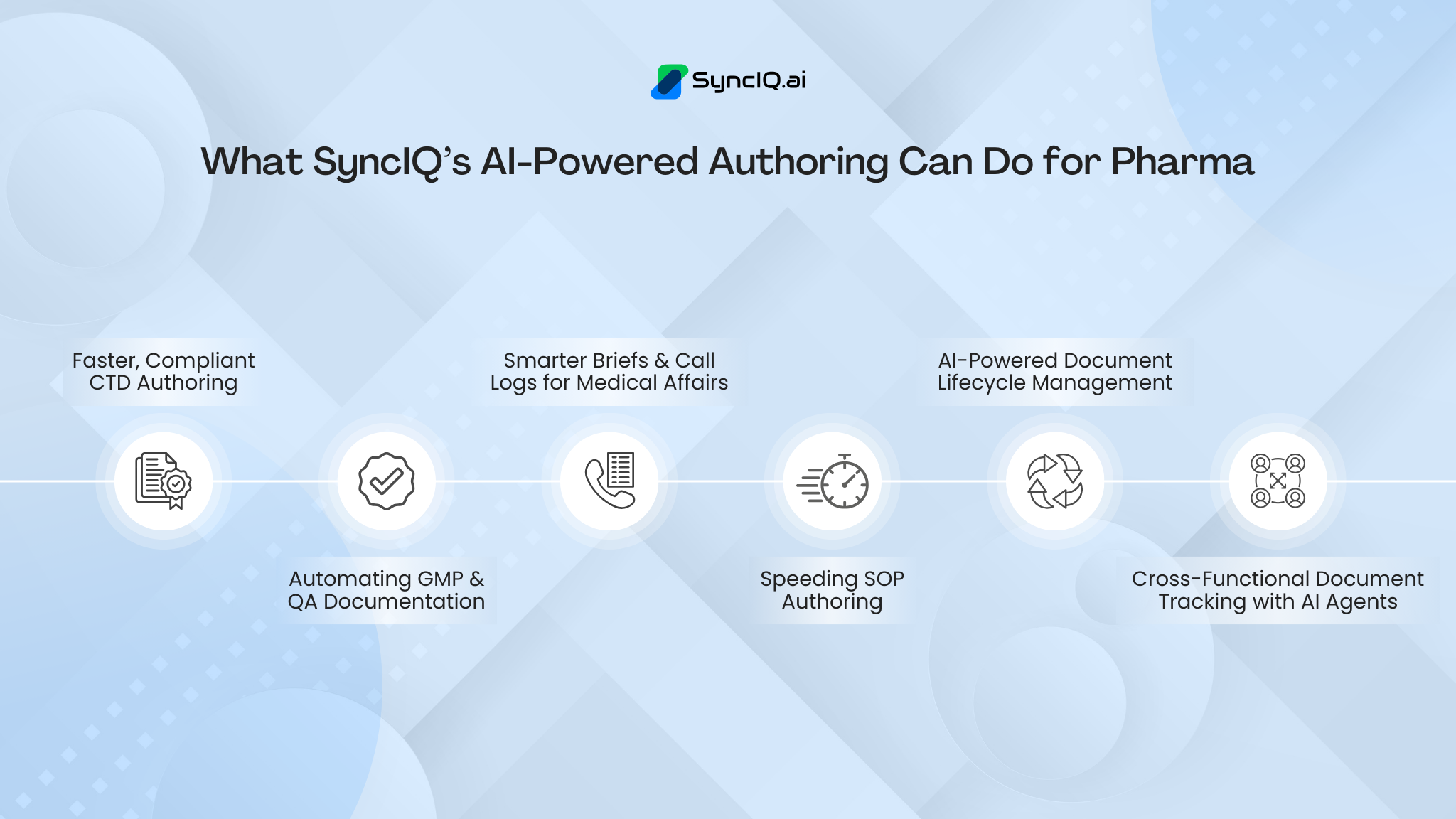
Faster, Compliant CTD Authoring
CTDs are heavy, rigid, and compliance-sensitive. Manually drafting these documents is time consuming and prone to error.
- AI can generate full CTD sections from verified data stored centrally.
- It can even embed ICH rules and run compliance checks on formatting, missing fields, or inconsistencies, letting writers prompt a draft rather than build every paragraph from scratch.
A comparative study in regulatory drafting found that an AI tool cut first-draft time by over 97% (from ~100 hours to ~3.7 hours) for large filings. (source: McKinsey & Company)
Automating GMP and QA Documentation
Quality teams often drown in deviation logs, batch records, and CAPA tracking.
- AI can fetch electronic batch manufacturing records (EBMRs) and validate entries against SOPs and master batch records.
- Exceptions get flagged, structured summaries get generated, and root cause analyses or CAPA actions get prepared. QA still reviews and approves the final output.
This shifts QA reviewers from redlining text to making judgment calls on content already mostly formed.
Smarter Briefs and Call Logs for Medical Affairs
MSLs spend a lot of time prepping for calls and logging what was discussed.
- AI can draw data from CRM, prior interaction notes, and scientific sources to auto-generate pre-call briefing documents.
- After the meeting, it drafts the formal call summary that fits compliance requirements.
Less administration, more preparation and engagement with HCPs.
Complete SOP Automation
SOPs are essential but a hassle to write. They’re structured, repetitive, and have to follow regulatory conventions.
- AI can build a complete compliant skeleton (sections, numbering, formatting).
- It embeds relevant regulatory guidelines and brings in examples from past SOPs.
- It can reuse or adapt existing content based on contextual cues (new process change, regulatory update, etc.).
No more blank pages, less rework, more consistency across SOPs.
AI-Powered Document Lifecycle Management
Managing document lifecycles across drafting, review, and approval stages is complex and fragmented.
- AI can maintain a live version of every document, showing real-time progress.
- Regulatory teams, for example, can track the status of each dossier section with lifecycle controls, giving them greater visibility, reducing confusion across versions, and ensuring smoother handoffs across teams.
Cross-Functional Data Tracking with AI Agents
Documents don’t exist in silos, but too often they’re managed that way.
- AI agents can connect across functions, from Regulatory to QA to Medical.
- With one prompt, pharma leaders can see how data updates affect multiple documents across functions, making it easier to spot risks, coordinate updates, and make strategic decisions faster.
What It Will Enable In The Future: A Look At Organization Maturity in Pharma and Where It Is Headed
Pharma organizations often sit at early levels of maturity where governance is informal, processes are reactive, and digital tools are patchy. A maturity model helps explain this: companies evolve from Initial → Managed → Defined → Quantitatively Managed → Optimized in capability and sophistication.
- Initial (Level 1): At this level, processes are temporary, documentation is fragmented, and success depends on individual effort.
- Managed (Level 2): At this level, some repeatable processes appear but many tasks still require manual coordination.
These early levels are where many pharma companies currently operate, especially in the regulatory, quality, and document workflows. When companies rise above “Managed” and move toward “Defined” and beyond, AI-powered authoring and document management unlock new possibilities. Here’s what the future could look like:
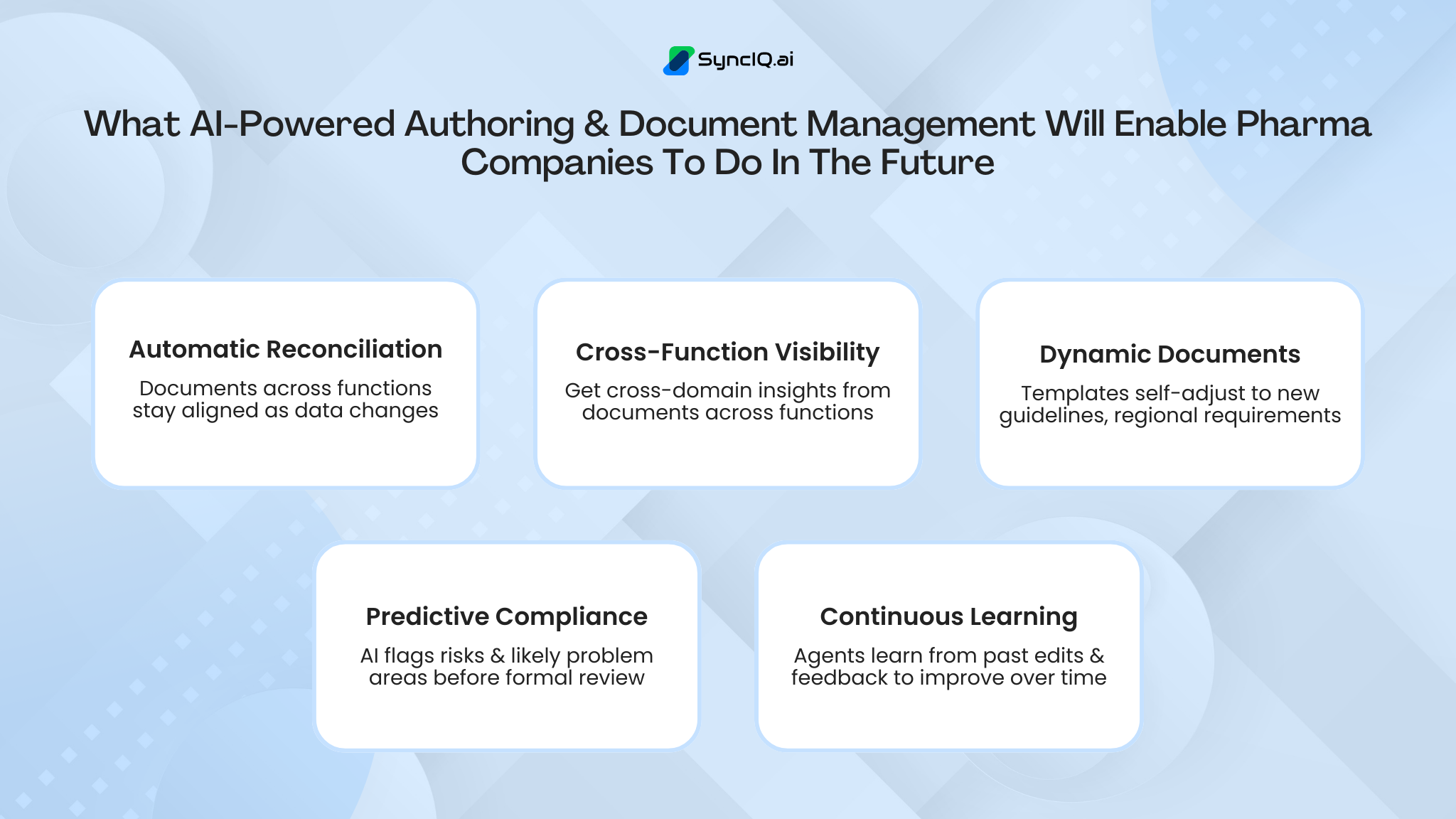
1. Automated Reconciliation & Version Harmony: Documents across regulatory, quality, clinical, and medical affairs will reconcile automatically. So when a data point changes, all related sections across dossiers, SOPs, and safety reports update coherently. Version conflicts will be minimized by design, not by additional headcounts or unlimited review cycles.
2. Holistic Intelligence Across Functions: AI agents will monitor changes across functions and serve leaders with cross-domain insights. For example, a change in data will trigger alerts across RA, QA, and manufacturing documents.
3. Dynamic Document Networks: Documents will behave like nodes in a network where updates flow according to dependencies, version logic, and business rules. Adaptive templates will self-adjust to new regulatory guidelines, data formats, or regional requirements.
4. Predictive Risk & Compliance Insights: AI will flag sections at risk of non-compliance or inconsistency before review, based on patterns, historical inspections, or regulatory change signals. And dashboards will forecast “hot spots” (e.g. sections needing rework, high churn areas) proactively.
5. Embedded Organizational Learning: AI Agents will learn from review cycles, user corrections, and regulatory feedback to improve drafting, compliance heuristics, and document structure over time. The organization’s collective knowledge about “how to write well for this context” becomes embedded in the system.
The Impact: What Changes When Documents Don’t Drag You Down
Here’s what companies actually gain:
- Speed & Efficiency: Tasks that took weeks of manual work can be drafted in hours, accelerating the creation of submission dossiers, quality reports, and clinical summaries.
- Quality & Compliance: AI enforces consistency in terminology, formatting, and data across thousands of pages, producing a higher-quality submission and a stronger, more defensible audit trail.
- Human Focus Redirected: When experts are freed from manual document work, they can apply their skills to more valuable tasks. Scientists can spend more time on research. Regulatory professionals can focus on submission strategy. Quality experts can dedicate their efforts to process improvement
McKinsey estimates that AI adoption in Pharma could generate $60–110 billion yearly in value. (Source: McKinsey & Company) And firms already face over $1.1 billion in compliance penalties over recent years. (Source: GMP Pros)
Wrapping Up
Pharma's invisible bottleneck has always been document authoring. The industry has accepted it as a necessary cost of doing business. SyncIQ’s AI-powered authoring and document management challenges that assumption. It presents a clear path to turn this bottleneck into an enabler of faster approvals, safer drugs, and better patient outcomes.
Ready to see how SyncIQ can reclaim hundreds of hours for your team? Request a demo today and be part of our beta release to help design the future of documentation in Pharma.